the process of the extension from Borel set to the measurable space.
( some set that are null are not measurable (not borel set) —such as choosing one representator of each the class of the equivalance set of r where r in [0,1] —this set is not measurable since if it is null —contradiction (infinitely sumamation of 0 is not equal to [0,1]’s length 1; if it is measure with length greater than 0 then the infinitely many which should not be 1.)
Uniform Convergence is the most interesting topic that I have learned in this module! LOVELOVE, I love analysis!
Weierstrass continuous nowhere differentiable function
This example’s proof tells that the example of x to be 0 is important
The series construction method of this proof is very intrinsic.
Final exam review (most are about uniform convergence, which is really, really intereting for me since I have got some exercises from Prof. Andrew Lin and also Dr. Chi-Kwong Fok has helped me a lot in his office hours)
For \(x=0\) or if \(x\) is irrational, and \(x\in[c,d]\)
While the dream of becoming a pure mathematician has faded, my pursuit of Mathematical Analysis remains strong, driven by a desire to express my thoughts with precision and elegance. My ultimate aspiration of Analysis is to present ideas that captivate others, compelling them to listen. This is not just about sharing information; it’s about conveying logical insights that have been distilled through my own deep engagement with the material, reflecting a genuine and personal comprehension of the subject matter.
If a question is not trivial, we should know where is the difficulty of it
Here the difficulty is uncountable
eg. f is a continuous function on [0,1] \(\int_0^1 f(x) x^n dx =0\), prove that f(x)=0 for all x in [0,1].
we have \(\int_0^1 f(x) [a_nx^n+...+ax+a_0]dx=0\)
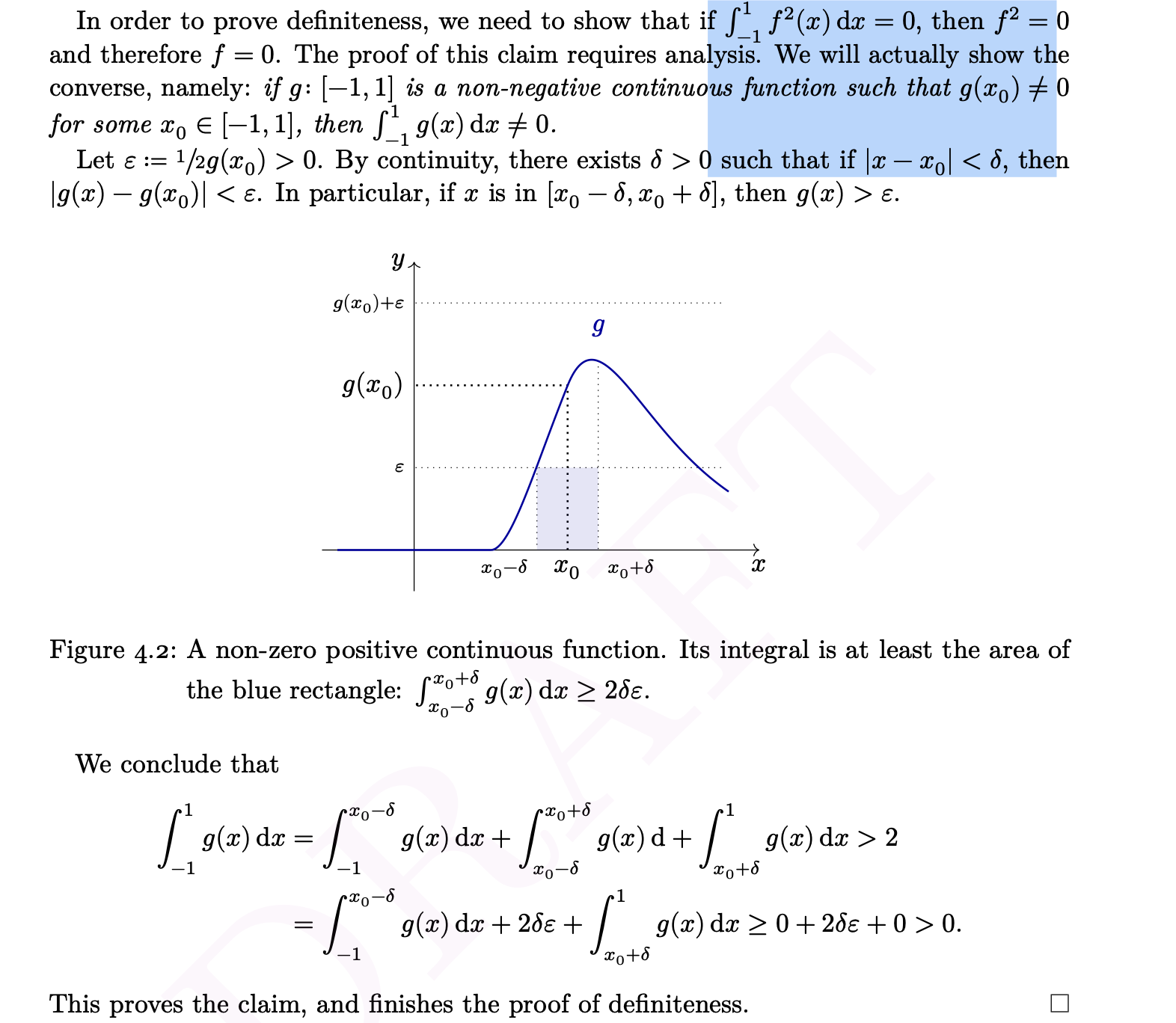
We have \(\int_0^1 |f(x)|^2 dx=0\) (Weierstrass Approximation Theorem and Since $ |f(x)|^2$ is not negative, Suppose f(x) is not equal to 0, then we could find a point x0 where f(x0) is not equal to 0, then we could find a small interval around x0 where f(x) is not equal to 0, then this interval’s integral could not be =0, which is a contradiction (the meaning of “continuity” is that if a point is greater than 0, then there is a neighborhood of this point where the function is greater than 0.))
We have \(|f|^2=0\) a.e. \(x\in [0,1]\)
So \(f(x)=0\) a.e. \(x\in [0,1]\)
uncountable is the difficulty of this question (density argument : The closure of Q is R means that \(\forall x \in R\)\(\exists x_n \in Q\) such that \(x_n\) converges to x)
So we use the proof by contradiction:
epislon-delta language is not important, the most important thing is to understand the essence of the proof and the logic behind it. It is better to see everything intuitively.
eg. The sum of continuous functions
2 functions
n functions
infinite functions —not continuous! –We could not choose the minimum \(\delta\) to make the sum continuous.
Now the content follows the time, not summary at all..
Understand intuitively (Never memorize anything in math!)
118 after mid-term
easy to think wrongly
If \(f'(x)\) exists, \((f^2)'\)= \(2f(x)f'(x)\) but the counter direction might not be true
eg. If \(f^2\) is differentialble and \(f^2 > 0\), then |f| is differentiable since we could write |f| as some function of f(x) and \(f^2\) is differentiable. So we could use the chain rule to show that |f| is differentiable. eg. \(|f|=e^{1/2lnf^2}\) or just \(|f|=\sqrt {f^2}\)
eg. If \(f^2\) is differentiable, and \(f^2 > 0\)\(f\) may not differentiable since f itself may NOT continuous at any \(x\in \mathbb{R}\). f(x) is 1 when x is rational and -1 when x is irrational. f(x) is not continuous at any point in \(\mathbb{R}\), so f(x) is not differentiable at any point in \(\mathbb{R}\).
Integrability
When we consider a continuous functon’s integrability on [a,b], we could divide the function into 2 parts—one is good and the other is bad. For the good part, the uniform continuity guarantes the integrability. For the bad part, we could use the property of boundedness to show that the integral is finite using very thin intervals to cover the bad part. So we could use the property of boundedness to show that the integral is finite using very thin intervals to cover the bad part.
Write logically
Each global expression should just appear once. When it has been introduced, we can regard it as a fixed thing and expand our proof behind logically.
eg
Suppose \(f\) is differentiable in \((c - \delta, c + \delta) \setminus \{c\}\) for some \(\delta > 0\) with \(\lim\limits_{x \to c} f'(x) = A\) exists, and \(f\) is continuous at \(c\). Show that \(f'(c)\) exists and \(f'(c) = A\) in the following two ways:
By applying Lagrange’s Mean Value Theorem.
By applying L’Hospital’s Rule.
! Explain clearly how continuity of \(f\) at \(c\) is used in your argument in each case.
proof:
Let ε > 0. Since \(lim_ {x→c} f'(x) = A\) there exists δ > 0 such that ∀x ∈ (c - δ’, c + δ’) {c}, |f’(x) - A| < ε (*) .
Now, take x ∈ (c - δ’, c + δ’) {c}.
We have that f is continuous on the closed interval between x and c and differentiable on the open interval between x and c.
So by Lagrange’s MVT we have ∃ξ between x and c s.t.
(f(x) - f(c)) / (x - c) = f’(ξ)
Hence, we have that
|(f(x) - f(c)) / (x - c) - A| < ε by (*) because |f’(ξ) - A| < ε.
Hence \(lim_{x→c} (f(x) - f(c)) / (x - c) = A.\)
i.e. f’(c) = A
All ways to distinguish whether it is uniformly continuous
please fill this before your final exam!
practice before my mid-term exam (my way to think that of question is like this)
\(f(x) = x^4\) is not uniformly continuous on \(\mathbb{R}\).
So \(0 < |x_n - y_n| < \frac{1}{4 \sqrt[4]{n^3}}\)
So \(\lim_{n \to \infty} |x_n - y_n| = 0\) by squeeze theorem
So for \(\varepsilon_0 = \frac{1}{2}\), by the definition of limit,\(\forall \delta > 0\), \(\exists m > 0\) s.t. for \(n_0\in \mathbb{N} > m\), \(|x_{n_0} - y_{n_0}| < \delta\) but \(|f(x_{n_0}) - f(y_{n_0})| = 1 > \varepsilon_0 = \frac{1}{2}\),
This satisfies the negation of the definition of “uniformly continuous”.
Uniform convergence
eg of an interesting function
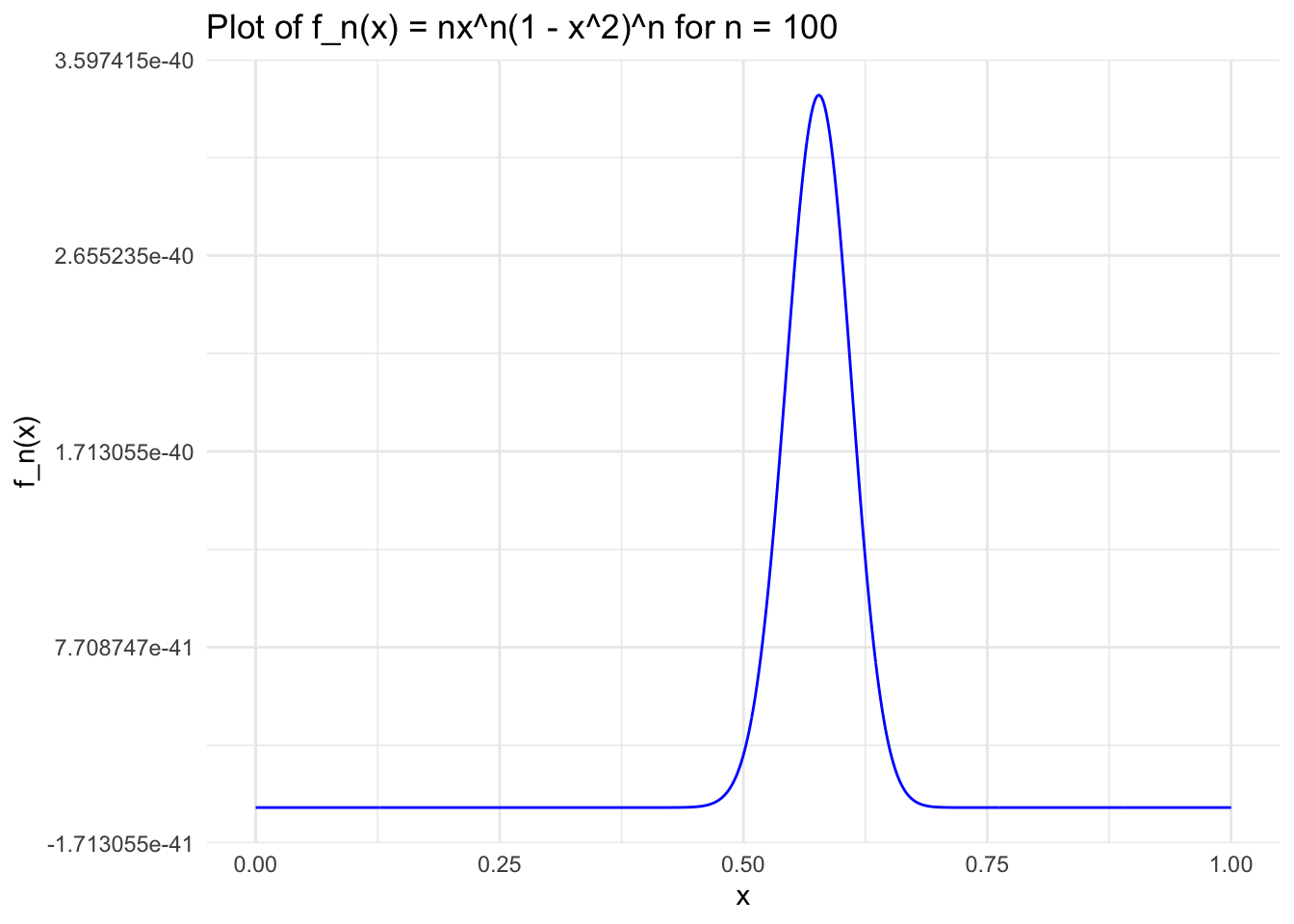
\[f_n(x)=nx^n(1-x^2)^n\]
This function has a pointwise limit of 0 by squeeze theorem and L’Hospital’s theorem.
It is easy to check the change of its limit and integral is not the same, i.e. \(lim_n \int_0^1 f_n(x)\) is not equal to \(\int_0^1 lim_n f_n(x)\), so it is not uniformly convergent.
If we look at the limit of its supremum, we could find that the supremum of this function is \(\infty\) when n is large enough. So we could use the supremum to show that the limit of this function is not uniformly convergent. This is not trivial to understand since its pointwise limit is 0 but the supremum is \(\infty\). That is because when n is very large, there is a very thin but tall peak, which makes the supremum of this function to be \(\infty\).
Or we also firstly draw this picture and find intuitively that its supremum is \(\infty\) when n is large enough. So we could use the supremum to show that the limit of this function is not uniformly convergent.
# Load necessary librarylibrary(ggplot2)# Define the functionf_n <-function(x, n) {return(n * x^n * (1- x^2)^n)}# Set the value of nn <-100# Create a sequence of x values from -1 to 1x_values <-seq(0, 1, length.out =1000)# Compute the corresponding y valuesy_values <-sapply(x_values, f_n, n = n)# Create a data frame for ggplotdata <-data.frame(x = x_values, y = y_values)# Plot the function using ggplot2ggplot(data, aes(x = x, y = y)) +geom_line(color ="blue") +labs(title =paste("Plot of f_n(x) = nx^n(1 - x^2)^n for n =", n),x ="x",y ="f_n(x)") +theme_minimal()
Preface
The first section here is the knowledge that attracts most of my interests on this module, followed by the lecture notes I tapped when I am on the journey of this module.
The begining main idea of Analysis about the establishment of real number
Motivation
f(x)+f(y)=f(x+y) (addition in linearity in linear transformation)
(a line across the original point)
1–>1+1–>1+1+1—>n positive integer(addition is needed/1 is needed)
0—>0-1—0-1-1—-n positive integer(addition is needed/0 is needed)
\(\frac{p}{q}\)—- rational number(multiplication is needed)
Since the rational number is countable(|N|=|N\(\times\)N|=|Q|) but irrational number is uncountable, we could not directly go ahead from Q to R\Q. Fortunately, we have the property of density of irrational number(of course also rational number) in R. In this case we could introduce limit here, and also continuity
This means that, usually, if a situation in rational number is true, then in the whole real number it is almost true.
Finally we get a whole line across the original point here.
Example1
If f(x) is continuous on R. g(x)=f(x) when x is a rational number. Then we have g(x)=f(x) on R.
Proof
Use sequence to think intuitively and write down the proof rigorously:
Without loss of generalization, here we let our R-continuous function to be \(x^2\).
question: If f is continuous on [a,b], f(x)=\(x^2\) if x \(\in\) R\Q. Show: f(x)=$x^2, xR $ in [a,b]
proof:
Firstly we write down Sequential criterion of limit which we will use to finish the proof:
(Sequential criterion for limits of functions). Let \(f: A \rightarrow \mathbb{R}\). The following are equivalent. 1. \(\lim _{x \rightarrow a} f(x)=\ell\). 2. For any sequence \(\left(a_n\right)_{n \in \mathbb{N}}\) with \(a_n \in A, a_n \neq a\) and \(\lim _n a_n=a\), we have \[
\lim _n f\left(a_n\right)=\ell
\]
Proof. (1) \(\Rightarrow\) (2): Suppose \(\lim _{x \rightarrow a} f(x)=\ell\). Then \(\forall \varepsilon>0, \exists \delta>0\) such that \(\forall x\) with \(|x-a|<\delta\) and \(x \neq a\), we have \[
|f(x)-\ell|<\varepsilon
\]
Let \(\lim _n a_n=a, a_n \in A\) and \(a_n \neq a\) for all \(n \in \mathbb{N}\). Then for the \(\delta>0\) above corresponding to \(\varepsilon, \exists k \in \mathbb{N}\) such that \(\forall n \geq k, n \in \mathbb{N}\), we have \[
\left|a_n-a\right|<\delta
\] which implies \[
\left|f\left(a_n\right)-\ell\right|<\varepsilon .
\]
That shows that \(\lim _n f\left(a_n\right)=\ell\). \((2) \Rightarrow(1)\) : Suppose for the sake of contradiction that \(\lim _{x \rightarrow a} f(x) \neq \ell\). Then \(\exists \varepsilon_0>0\) such that \(\forall \delta>0, \exists x\) with \(|x-a|<\delta\) and \(x \neq a\) such that \[
|f(x)-\ell| \geq \varepsilon_0
\]
We construct a sequence as follows. Take \(\delta=\frac{1}{n}\). Then \(\exists a_n\) with \(\left|a_n-a\right|<\delta=\frac{1}{n}\) and \(a_n \neq a\) such that \(\left|f\left(a_n\right)-\ell\right| \geq \varepsilon_0 . a_n\) satisfies \[
a-\frac{1}{n}<a_n<a+\frac{1}{n} .
\]
By letting \(n \rightarrow+\infty\) and using the Squeeze Theorem(or we could use another method to finish argument here by constructing only one sequence (choose \(\delta\) to be \(1/n\) also and then always find one \(x_n\) in the \(\delta-\) neighborhood and this \(x_n\) is also convergent to a)), we have \(\lim _n a_n=a\). So by the given condition, \(\lim _n f\left(a_n\right)=\ell\). However, for all \(n \in \mathbb{N}\), \[
\left|f\left(a_n\right)-\ell\right| \geq \varepsilon_0 \Rightarrow f\left(a_n\right) \geq \ell+\varepsilon_0 \text { or } f\left(a_n\right) \leq \ell-\varepsilon_0 .
\] contradicting to f\((a_n)\) is convergent.
Now we begin our proof:
We have known that if \(a_n\in\) R/Q f(a\(_n\))=\({a_n}^2\)
Since we have the property of “irrational numbers are dense on R” we know that \(\exists a_n\in(a-1/n,a+1/n), \forall n\in N, a\in Q\). This constructs our sequence \(a_n\) such that \(lim_{n\rightarrow \infty} a_n=a, a\in Q\)
This implies that \(lim_{n\rightarrow\infty}f(a_n)=f(lim_{n\rightarrow\infty}a_n)\)=f(a).
(The first equality is because of this proposition:(Limit of composition of functions). Let \(f: A \rightarrow \mathbb{R}, g: B \rightarrow \mathbb{R}\) such that \(R(f) \subseteq B\). If \(\lim _{x \rightarrow a} f(x)=\ell\) and \(g(x)\) is continuous at \(\ell\), i.e. \(\lim _{x \rightarrow \ell} g(x)=g(\ell)\), then \[
\lim _{x \rightarrow a} g(f(x))=g(\ell)=g\left(\lim _{x \rightarrow a} f(x)\right) .
\] proof:Proof. \(\forall \varepsilon>0, \exists \delta>0\) such that \(\forall y\) with \(|y-\ell|<\delta\) and \(y \in B\), we have \[
|g(y)-g(\ell)|<\varepsilon
\]
For this \(\delta, \exists \delta^{\prime}>0\) such that \(\forall x\) with \(0<|x-a|<\delta^{\prime}\) and \(x \in A\), we have \[
|f(x)-\ell|<\delta
\]
So if \(0<|x-a|<\delta^{\prime}\) and \(x \in A\), then \(|f(x)-\ell|<\delta\) and \(f(x) \in B\), which imply that \(|g(f(x))-g(\ell)|<\varepsilon\). This proves the proposition. )
This could prove the definiteness in an innner product while also show the good quality of continuous function—-one point>0, the whole neighborhood>0
Continuous function
Sequences
We could see the situation of continuity of a function firstly and intuitively by SEQUENCES then give a proof using limit(sequential criteria of limit), squeeze Thm(directly or constructing sequences),
e.g Thomas function
e.g
My main Analysis learning instructions(philosophy): Theorems come, theorems go, only examples lie forever.
Maybe I could not remember all process of each profound theorems proof, but I could also understand Analysis in depth by handling how to use theorems to solve problems.(But I need to try to know how the proof using each condition in the theorems and internalize it by continuousely thinking) In this case, examples help me a lot.
数学素养和人文素养的结合 一个好的证明是natural的 好的数学是具有普遍性(universal)的(大数学家先看二维再推广到n维) sequence is the most 直观来写分析 北极是无穷大 上帝是无穷 唯一的上帝 正无穷和负无穷最后归到一点 两个无穷大 傅立叶级数 周期函数–周期概念 傅立叶 transform
‘Existence’ means beyond any human efforts, and objectively existence. We take the value that we need means a human effort, and because it is arbitrary, we have the freedom to choose one. — Dr. Zhang
max and min need to be found
eg. Finite open sets’ intersection is also open because we can choose the minimum \(\epsilon\)
open set is like interval
Theorem
Let \(O\subset R\) be an open set then \(O=\cup_{n=1}^\infty I_n\) where \(I_n\) is an open interval in R
Def
A collection of open sets covers a set A if \(A\subset \cup O_\alpha\). The collection {\(O_\alpha\)} is called an open cover of A.
Theorem
Let C={\(O_\alpha\)} be a collection of open sets of real numbers then there is a countable subcollection {\(O_i\)} of C such that \(\cup_{O\in C}O=\cup_{n=1}^\infty O_i\)
Any open cover of a set of real numbers contains a countable subcover.
i have proved that:
the closure of \(Q\) = R <–> \(R\approx Q\) <–> \(\forall x\in R, \exists x_n\in Q\) such that\(x_n-->x\). Q is a countable, dense subset of R, R is separable.
accumulation point is different to limit point
eg. \(a_n=(-1)^n (n+1)/n\), 1 and -1 are accumulation points but not limit points because the sequence is not convergent
the usage of proof by contradiction in the proof of limit
eg.
albel: guass is a fox, 走过的地方狐狸尾巴扫掉了
algebra of continuity
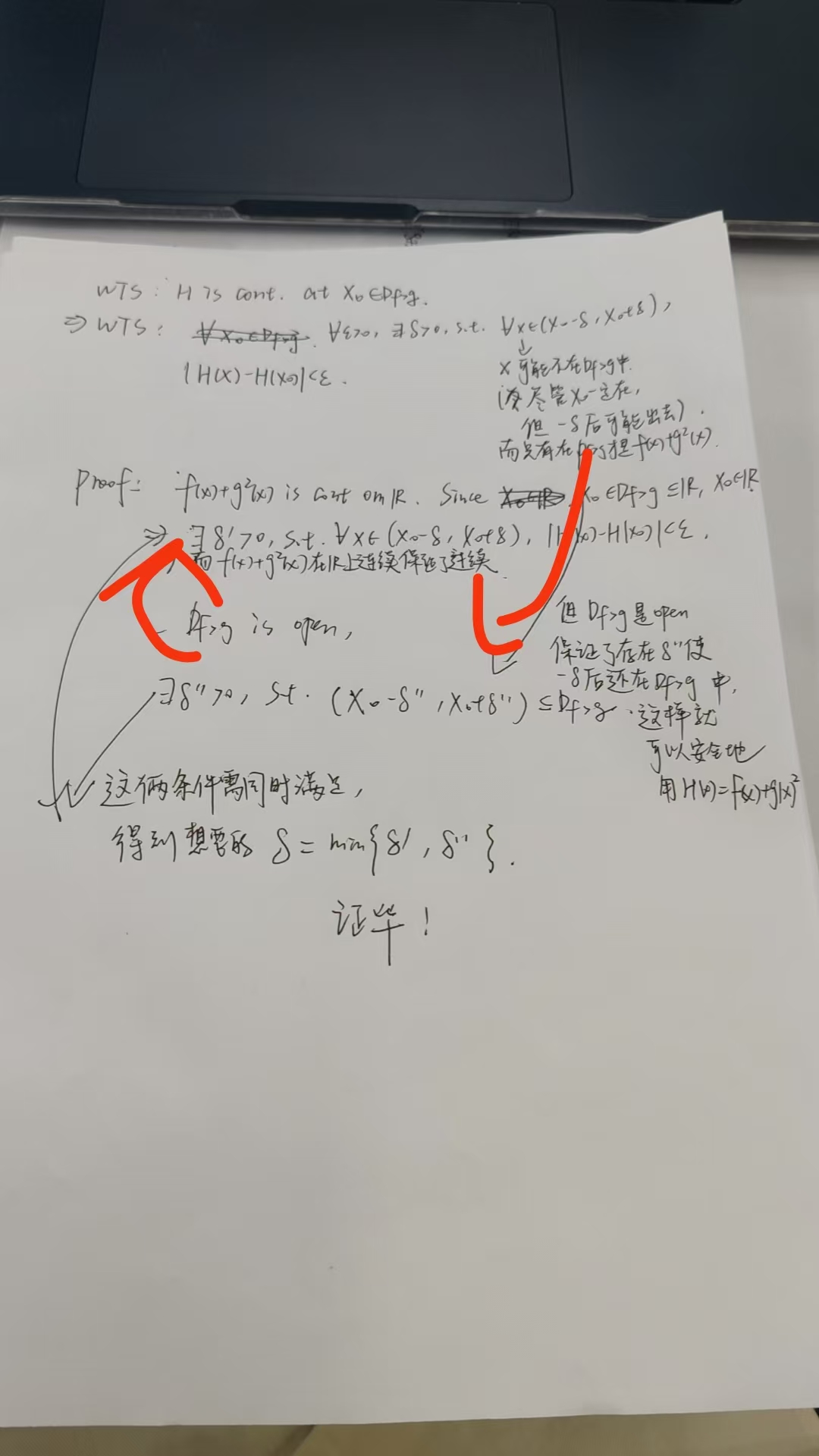
\(\exists \delta = min\){\(\delta_1,\delta_2\)}
Continuity
history
cauchy 1821(decrease indefinitely with those of \(\alpha\))–weierstrass 1874 (\(\epsilon-\delta\))—–
understanding in a long process
\(\delta\) decides how good the continuity of the function is.
Preface before
Cauchy 1822
What is a limit?–number
Until 1870, the answer to “What is the number” had been known.
cantor 1872年是不平凡的一年, 有(Weierstrass, Dedekind, Meray, Heine, Cantor)同时提出了实属系统建构的理解 出版著作解决困惑人们2500多年的问题
Weierstrass 法律 数学 喝酒 干架 退学 在中学里边仍然没有与学术脱节 复变函数 椭圆函数(研究在复数平面上的解析函数, C=\(R^2\) a+ib–>(a,b) is an isomorphism) \(C \cup {\infty}\) 相似于球面 \(S^2\) 约等于 \(R^2\cup \infty\) 变成closed and bounded one-point- compactfication 为什么实数不bounded因为无穷 无穷大这点不是实数(不满足实数性质—无穷大加无穷大还是无穷大;无穷大减无穷大是any number)因为
任何单调有界的实属序列都有极限存在—dedekind的假设
dedekind cut
if rational number
毕达哥拉斯的年代的万物皆数是有理数
古希腊哲学 古希腊数学
Thales
做测量工作创出非欧几何这门学问 真正的天才是能够创出一门学问的
牛顿是科学第一人 当人们迷迷糊糊的时候 他打开理性的光
这一切是黑暗的 上帝说让牛顿去吧 于是就有了光
改编圣经的话–文采
毕达哥拉斯定理的证明都是非常有创意的东西
毕达哥拉斯定理十个证明
读慢一点
心浮气躁
数学是需要耐心的
一个城市的发展不应该是盖房子 应该是好的博物馆音乐厅公园 提高人民素养
volume 2 多变数 stolze定理 divergent定理
limit sup limit inf –这个东西就是我的实数
Cantor-==柯西序列。距离概念
\(|a_m-a_n|-->0\). d(\(a_m,a_n\)–>0) metric
equivalent equation equivalent class 实数 实数是一个集合
cantor–集合论
定义是最难的
有共通之处–作为定义
会用定理很重要 不是高斯
用多了就知道是怎么一回事
定理给了条件 哪里用到什么条件 怎么用的
碰到好老师的重要性 姜立夫 量纲自然
complete的完备不是完美 不是 门掉了一个螺丝 找一个螺丝完完全全放上去发挥作用
认识自己 我是螺丝 完完全全发挥我的作用 把长处 恩赐发挥出来 就是complete
有理数在实数中有很多孔隙 把空隙。把accumulation point收紧来
closure of A = B
\(\forall b\in B, \exists\){\(a_n\)} \(\subset A\) such that \(a_n-->b\)
$AB $ not equals to $> 0 $
实数是唯一一个complete ordered field
代数结构—分配律
eg.complex number没有order所以我们定义norm
和闭区间套定理极限思想的联系和区别???
Thanks
Thanks to Professor Zhang for teaching us MTH117.
Thanks to Professor A Kun for giving our XJTLU students chances to learn from him, especially his sophisticated personal understanding of Mathematics(and his useful and effective exercise of Analysis). # sup之前的好题
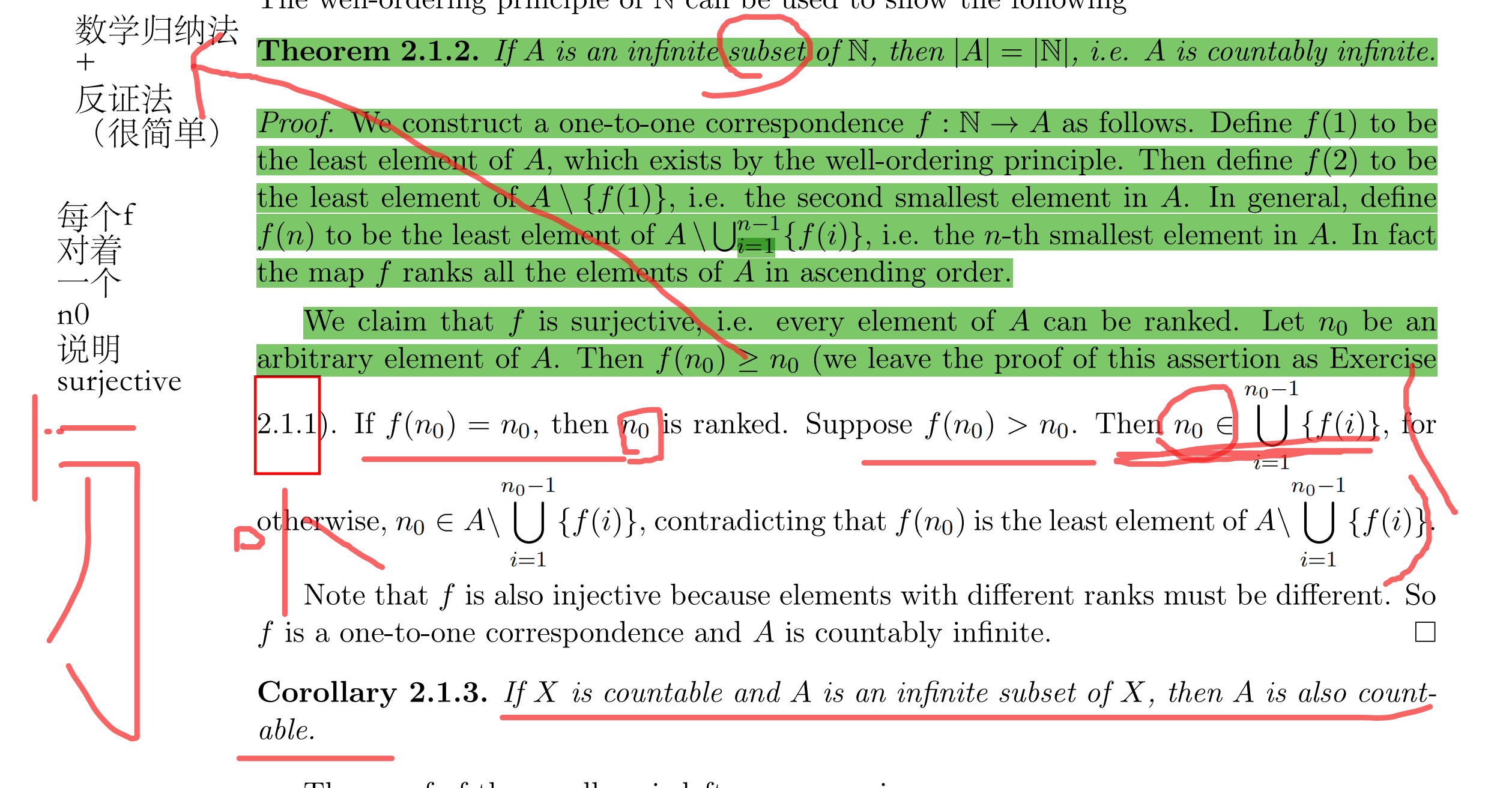
If A is an infinite subset of N, then |A| = |N|,i.e. A is countably infinite.
(Though using \(\epsilon\) is the most quickly way but I do not like it at all because it does not show the essence or nature of the supremum or infmum, which also has the part of luck because maybe I understand it totally but because of my poor calculation skill about construction I will not solve it, leading to unhappiness to myself.)
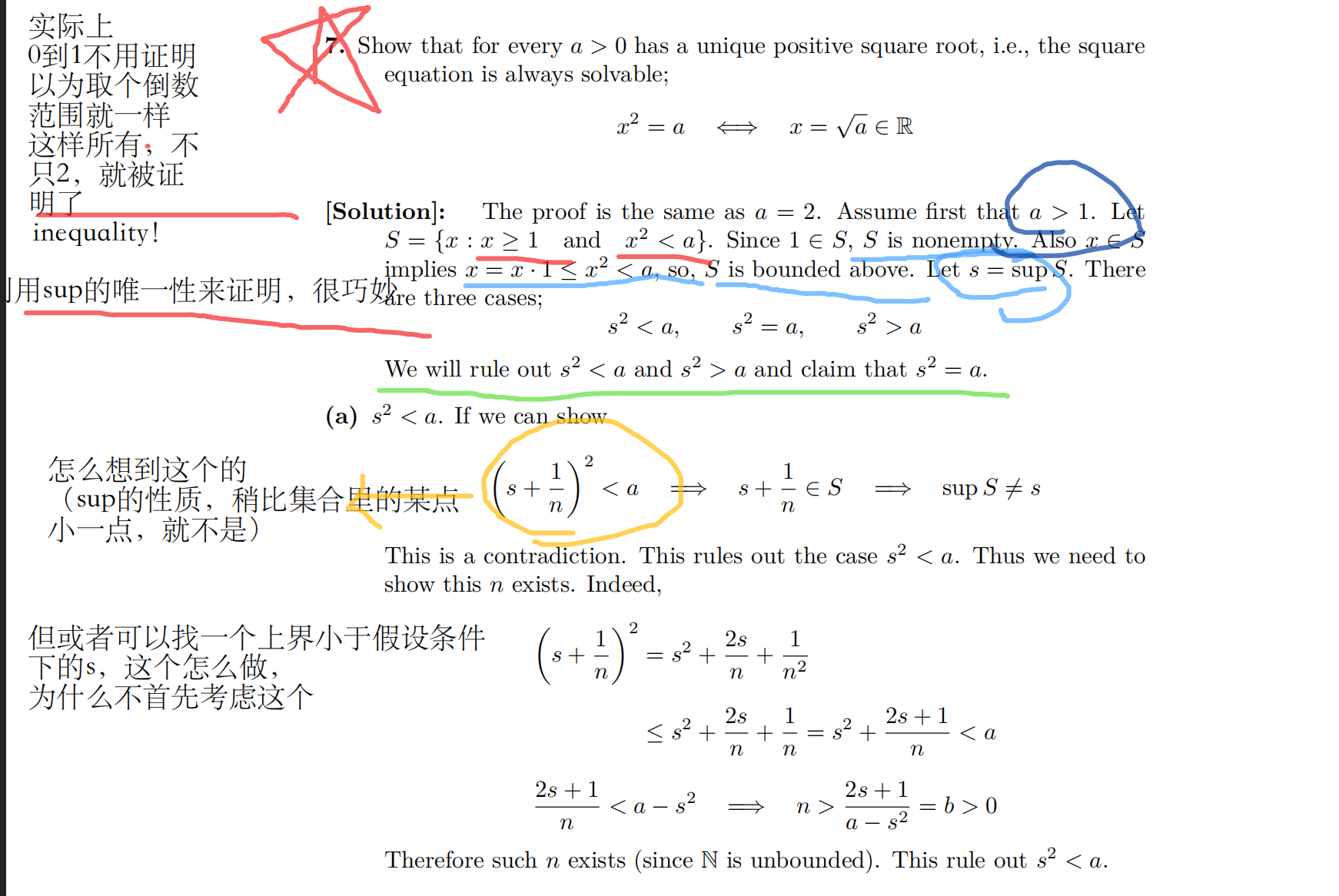
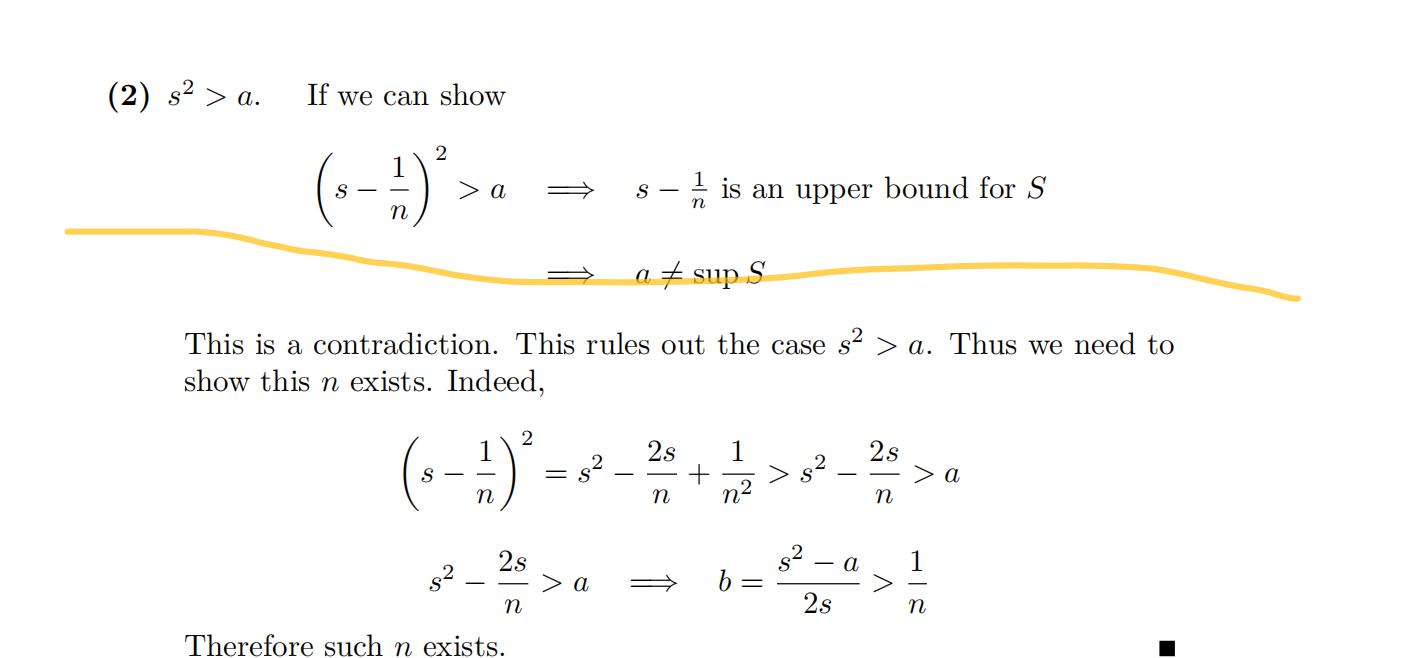
(notice! The rational number set does not satisfy completeness since if we choose a subset of Q, which is all rational numbers less than \(\sqrt2\), when we restrict this region on Q, its supremum does not exist.)
if a not empty set has upper bound, then it must have the unique sup.
Prove: if a not empty set has upper bound, then it must have the unique sup.
Method 1: (Completeness axiom)
\[
\begin{gathered}
X \neq \phi, \quad Y=\{y \in \mathbb{R} \mid \forall x \in X(x \leq y)\} \neq \phi \\
\\
\forall x \in X, \forall y \in Y, x \leq y \\
\\
\Rightarrow \exists c \in \mathbb R, \forall x \in X, \forall y \in Y, \\
\\
x \leqslant c \leqslant y(\text { Completeness axiom) } \\
\\
\Rightarrow(c \in Y) \wedge(\{\forall y \in Y \mid y \geqslant c\}) \\
\\
\Rightarrow c=\min Y
\end{gathered}
\]
So \(c\) is the only sup. (uniqueness of minimum element of a set—2 inequalities lead to the equality leading to the only one result).
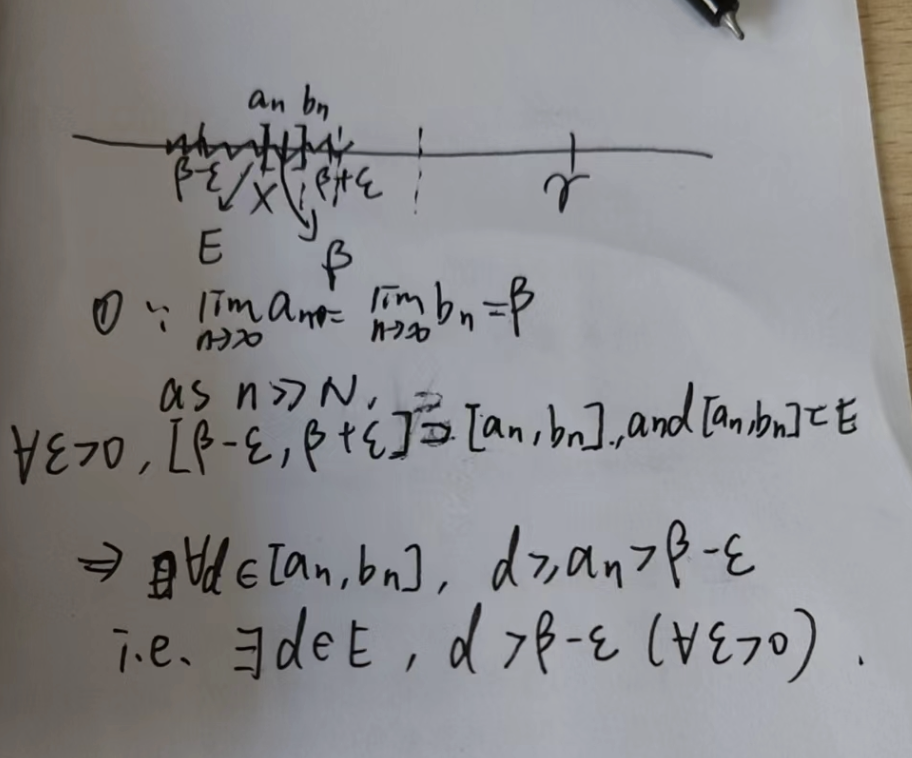
Method 2: Cantor Nested Interval Property(limit思想).asdfaskfkasdjklsad
We choose a random upper bound \(\gamma, x \in E(\) the set) \[
[x, r]=\left[a_1 b_1\right] \supset\left[a_2, b_2\right] \supset \cdots \left[a_n, b_n\right]
\] (each time we use the method of bisection to choose one side Including the point in \(E\) ) $$
\[\begin{aligned}
& \text { Since }\left[a_1, b_1\right] \supset\left[a_2, b_2\right] \cdots, b_n-a_n=\frac{\gamma-x}{2^{n-1}} \rightarrow 0, \\
& \beta \in\left[a_n, b_n\right],(n=1,2, \cdots), \lim _{n \rightarrow \infty} a_n=\lim _{n \rightarrow \infty} b_n=\beta \text {(limit thinking of the Cantor Nested Interval) } \\
& \Rightarrow \forall c \in E, c \leqslant b_n \Rightarrow c \leqslant \beta \text { (E } \text {is never on the right of} [a_n,b_n]) \\
& \Rightarrow \forall \varepsilon>0, \exists d \in E, d>\beta-\varepsilon\text { (each} [a_n,b_n] \text { has points in E.(or see the attached picture to see more picisely))}
\end{aligned}\]
If a not empty set has lower bound, then it must have the unique inf.
Method 1: same as before.
Method 2: Based on before.
Suppose We choose \(m\) as a lower bound of \(E\). \[
\begin{aligned}
& \Rightarrow \forall x \in E, x \geqslant m,-x \leqslant-m \text {. } \\
& \text { Let } F=\{-x \mid x \in E\} \text {. } \\
& \Rightarrow \beta=\sup F \\
& \Rightarrow-x \leqslant \beta, x \geqslant-\beta \text {. } \\
& \forall \varepsilon>0, \exists-d \in E,-d>\beta-\varepsilon, \\
& \Rightarrow d<-\beta+\varepsilon \\
& \Rightarrow-\beta=\inf E
\end{aligned}
\]\[
\Rightarrow-\sup (-E)=\operatorname{inf} E \text {. }
\]
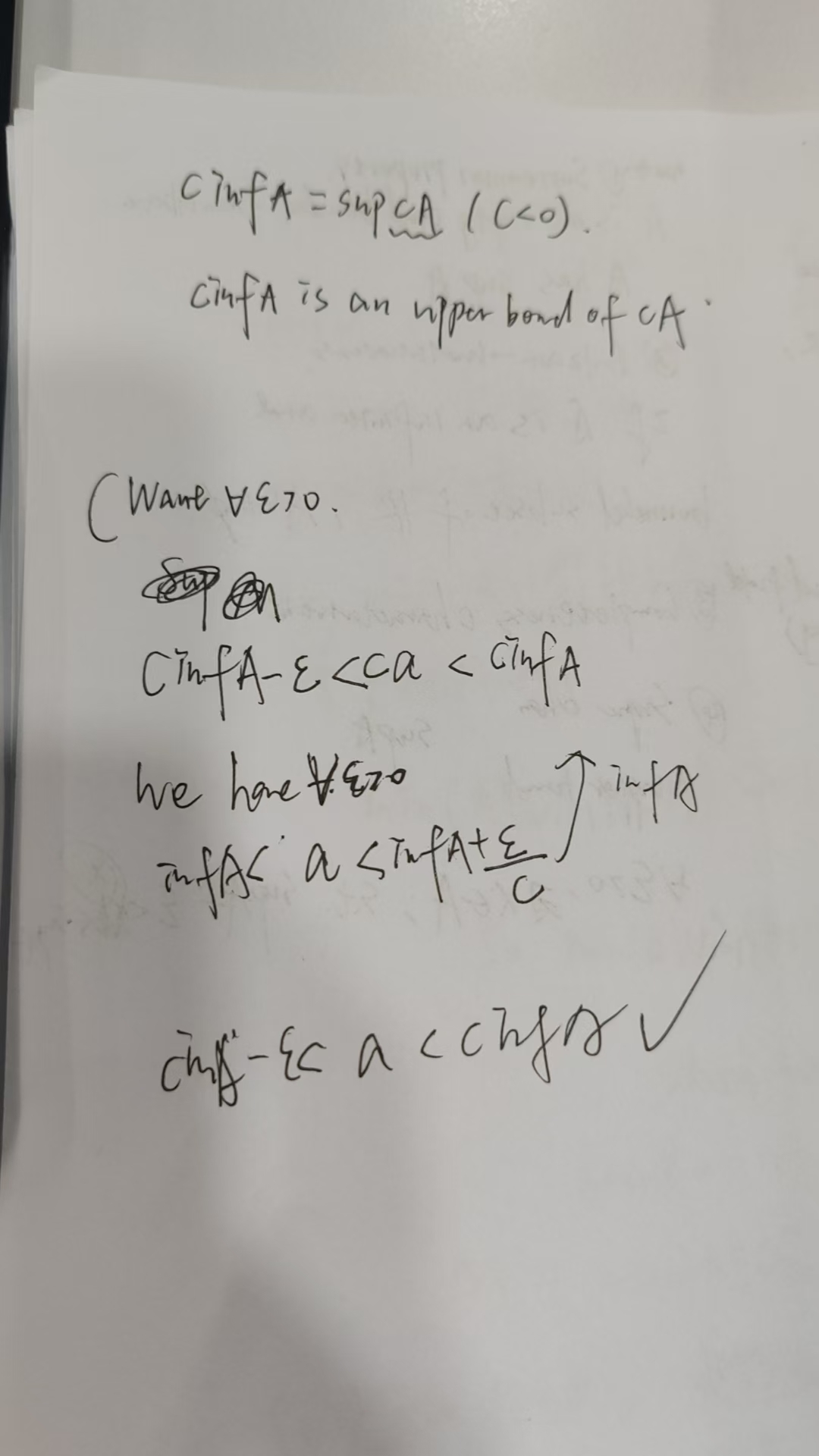
Method 3 more generalized than Method 2’s conclusion (if c is negative then inf(cA)=csupA)
In fact, If \(c<0\), then \(\sup (cA)=\operatorname{cinf} A, \inf (c A)=\operatorname{csup} A\). (and in particular. sup\((-B)=-\) inf \(B\) )
Since if M=supA, \(\forall x\in A,x\leq M,cx\geq cM\), which indicates that cM is the lower bound of cX.
So, \(cA\) has lower bound ( \(s\) )if and only if \(A\) has upper bound(s).(inverse, also true) \(cA\) is not empty if and only if A is not empty.
So, cA has \(\inf (cA)\) if and only if \(A\) has supA \[
\begin{aligned}
& \forall c x \in C A, c x \geqslant c M \\
& \text { if } \exists c M', \forall c x \in c A, c x \geqslant c M^{\prime}, c M^{\prime}>c M, \\
& X \leq M^{\prime}, M^{\prime}<M(\forall x \in A)
\end{aligned}
\]
Contradicting to the condition that \(M=\sup A\)
So \(\nexists C M^{\prime}\) So cM is the largest lower bound \[
\begin{aligned}
& \text { so } c M=\inf (c A) \\
& \text { so } c\sup A=\inf (c A)
\end{aligned}
\]
exercise: (1,2]’s sup–
Method 1
2 is an upper bound of [1,2) (obviously)
if \(\exists \varepsilon>0\), s.t \(2-\varepsilon\) is also an upper bound of \([1,2)\)\[
\begin{aligned}
& \because 1 \in[1,2) \\
& \therefore2-\varepsilon \geqslant 1
\end{aligned}
\] choose \(2-\frac{\varepsilon}{2} \in(2-\varepsilon, 2)\) Then \(2-\frac{\varepsilon}{2} \in[1,2)\) So \(\exists\left(2-\frac{\varepsilon}{2}\right) \in[1,2)\) while \(\left(2-\frac{\varepsilon}{2}\right)>(2-\varepsilon)\) So \(2-\varepsilon\) is not an upper bound, contradicting to the suppose. So we have proved that 2 is the smallest upper bound, i.e. \(\sup [1,2)=2\).
Method 2
2 is an upper bound of [1,2) (obviously)
\(\forall \varepsilon>0, \exists b \in[1,2)\) with \(b>2-\varepsilon\). We can take \(b=\max \left\{2-\frac{\varepsilon}{2}, 1\right\}\).
exercise: supC=sup(A+B)=supA+supB from Professor A Kun
\[
\begin{array}{rl}
\text { if } A\subset R, B\subset R, \text { define: } \\
C :=A+B=\{z \in R: z=x+y, x \in A, y \in B\} \\
D :=A-B=\{z \in R: z=x-y, x \in A, y \in B\}
\end{array}
\] show that \[
\begin{aligned}
& \text { (1) } \sup C=\sup (A+B)=\sup A+\sup B \\
& \text { (2) } \sup D=\sup (A-B)=\sup A-\inf B
\end{aligned}
\] (1) Proof:: Obviously,\(C\) has upper bounds if and only if \(A\) and \(B\) have upper bounds, and \(C\) is not empty. So \(C\) has sup C if and only if and only if \(A\) has sup \(A\) and \(B\) has sup \(B\). (Completeness axiom).
prove: \(\sup C \leqslant \sin A+\sup B\). \[
\because x+y \leqslant \sup A+\sup B
\]\(\therefore(\operatorname{sip} A+\sup B)\) is an upper bound of \(C\)\[
\therefore \sin C \leqslant \sin A+\sup B
\]
Prove : \(\sup C \geqslant \operatorname{supA}+\) sup B \[
\begin{aligned}
& \because \forall \varepsilon>0, \exists x \in A, y \in B \text {, s.t. } \\
& \operatorname{sup} A-\varepsilon<x, \operatorname{sup} B-\varepsilon<y . \\
& \Rightarrow \sup A+\sup B-2 \varepsilon<x+y \\
& \text { i.e. }(\operatorname{sup} A+\sup B-2 \varepsilon)_{\text {max }}<(x+y)_{\text {max }}
\end{aligned}
\]
Since \(x+y \leq\) sup c We have \(\sup A+\sup B-2 \varepsilon<\sup c, \forall \varepsilon>0\)\[
\begin{aligned}
& \text { i.e. } \operatorname{(sup} A+\sup B-2 \varepsilon)_{\text {max }}<\sup C \\
\end{aligned}
\]
We. As \(\varepsilon \rightarrow 0\), We have \(\operatorname{sup} A+\sup B \leqslant \operatorname{} \operatorname{sup} C\) So, we have \(\operatorname{Sup} C=\operatorname{Sup} A+\operatorname{Sup} B\). Then, we have \(\sup D=\sup (A-B)\)\[
\begin{aligned}
& =\sup (A+(-B)) \\
& =\sup A+\sup (-B) \\
& =\sup A-\inf B
\end{aligned}
\] (We have proved \(\sup (-B)=-\inf B\) before)
another example
 Let M ∈ R and A, B be two bounded, negative subsets of R,0 < x, y < M, ∀x ∈ A, y ∈ B
when we are proving sup C = sup(AB) = sup A · sup B
On the other hand, from the definition of $a^*$ and $b^*, \forall \epsilon>0$ there exist $a \in A$ and $b \in B$ such that
\[
a^*-\epsilon<a<a^* \quad \text { and } \quad b^*-\epsilon<b<b^*
\]
Then \[
\left(a^*-\epsilon\right)\left(b^*-\epsilon\right)<a b \leqslant a^* b^*
\] or ignoring \(\epsilon^2\) term (If ε > 0, then ε, 3ε, ε², ε⁵, they all represent “any number greater than zero”, and ε’ also represents any number greater than zero, so they are equivalent, that is, we can say that they are equal to ε’.) \[
a^* b^*-(a+b) \epsilon=a^* b^*-\epsilon^{\prime}<a b \leq c^*
\]
This is true for all \(\epsilon^{\prime}>0\), so \[
\sup A \sup B=a^* b^* \leq c^*=\sup C
\]
Combining the above two inequalities, we can conclude that \(\sup A \sup B=\)\(\sup C\). ## an exercise about think good Archimedean number from Professor Andrew Lin(A Kun)
Consider the set \[
A=\left\{\left.(-1)^n\left(1-\frac{1}{n}\right) \right\rvert\, n \in \mathbb{Z}^{+}\right\} .
\]
Show that 1 is an upper bound for \(A\).
Show that if \(d\) is an upper bound for \(A\), then \(d \geq 1\).
Use (a) and (b) to show that \(\sup A=1\). [Solution]:
We will show that for any \(x \in A, x \leq 1\). Since \(x \in A\), then \(x=(-1)^n(1-\)\(1 / n\) ) for some \(n \in \mathbb{Z}^{+}\). Since \(\frac{1}{n}>0\), then \(1-\frac{1}{n}<1\). We argue our desired inequality in two cases. If \(n\) is even, then \(x=(-1)^n(1-1 / n)=1-1 / n<1\). If \(n\) is odd, then \(x=(-1)^n(1-1 / n)=-1+1 / n<0<1\). In either case, \(x \leq 1\) (in fact, \(x<1\) ) and 1 is an upper bound for \(A\).
Let \(d\) be an upper bound for \(A\). Thus, \((-1)^n(1-1 / n) \leq d\) for all \(n \in \mathbb{Z}^{+}\). Assume, to the contrary that \(d<1\). Thus, \(1-d>0\). By the Archimedean Property, there exists an \(n \in \mathbb{Z}^{+}\)such that \(1<(1-d) n\). Since \(n>0\), we can rewrite this as \(\frac{1}{n}<1-d\), which is equivalent to \(d<1-\frac{1}{n}\). If \(n\) is even, then \((-1)^n=1\) and we have that \[
d<(-1)^n\left(1-\frac{1}{n}\right) \in A
\] contradicting the fact that \(d\) is an upper bound. If \(n\) is odd, then consider instead \(n+1\), which is even. Then, \((-1)^{n+1}=1\) and \[
d<1-\frac{1}{n}<(-1)^{n+1}\left(1-\frac{1}{n+1}\right) \in A
\]
This again contradicts that \(d\) is an upper bound for \(A\). Either way, we reach a contradiction and therefore conclude that \(d \geq 1\).
another exercise about another episilon from Professor A Kun
Find the least upper bound for the following set and \[
A=\left\{\frac{1}{2}, \frac{2}{3}, \frac{3}{4}, \cdots, \frac{n}{n+1}, \cdots\right\}
\] [Solution]: We note that every element of \(A\) is less than 1 since \[
\frac{n}{n+1}<1, \quad n=1,2,3, \cdots
\]
We claim that the least upper bound is \(1, \sup A=1\). Assume that 1 is not the least upper bound. Then there is an \(\epsilon>0\) such that \(1-\epsilon\) is also an upper bound. However, we claim that there is a natural number \(n\) such that \[
1-\epsilon<\frac{n}{n+1}
\]
This inequality is equivalent to the following sequence of inequalities \[
1-\frac{n}{n+1}<\epsilon \quad \Longleftrightarrow \quad \frac{1}{\epsilon}-1<n
\]
Reversing the above sequence of inequalities shows that if \(n>\frac{1}{\epsilon}-1\), then \(1-\epsilon<\frac{n}{n+1}\) showing that \(1-\epsilon\) is not an upper bound for \(A\).
(if n > 1/ \(\epsilon\)-1, \(\nexists \epsilon\) s.t. 1-\(\epsilon\) is an upper bound, contradicting to our suppose)
This verifies our answer.
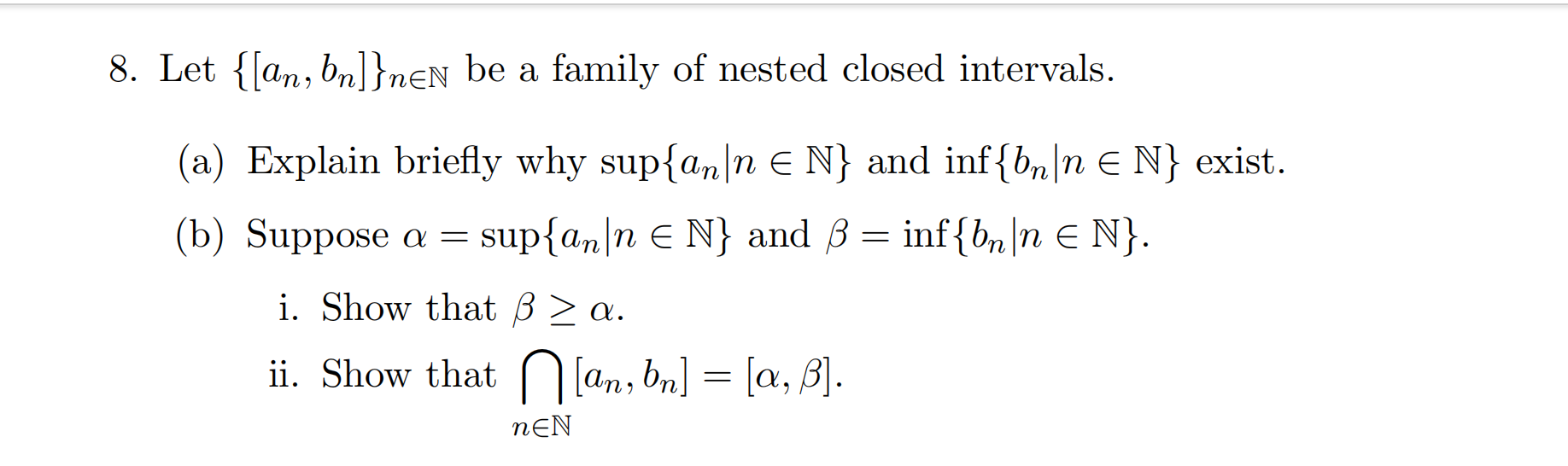
Prove Cantor Nested Interval Property
Prove:
\(\exists c \in\) all closed internals
i.e. if the non-empty closed intervals \(I_1 \supset I_2 \supset I_3 \cdots, \exists c \in R\), s.t. \(c\in I_i, \forall i \in \mathbb{N}\), \(c \in\)\(\bigcap_{i=1}^{\infty} I_i\)
If the limit of the lengths of these intervals are 0 then the point is unique
i.e. if\(\left|I_n\right| \rightarrow 0\), c is unique
claim \(\forall I_n=[a_n, b_n], I_m=[a_m, b_m]\) i.e. \(a_n \leq b_m\)
(if \(a_n>b_m\), then \(a_m \leq b_m<a_n<b_n\), which means they are separate internals without any intersection.) \[
\begin{aligned}
&\text { Let } X=\left\{a_n\right\} (\text { left endpoint set) } \\
&\text { Let } Y=\left\{b_m\right\}(\text { right endpoint set) } \\
& \forall a_n \in X, \forall b_m \in Y, a_n \leq c\leq b_m
\end{aligned}
\]\(\Rightarrow \exists c \in \mathbb{R}\), s.t., \(\forall a_n \in X\)\(\forall b_m \in Y,a_n\leqslant b_m\).(completeness axiom) We then let \(m=n \Rightarrow c \in I_n\)
proof of 2
Based on “Any implication is equivalent to its contrapositive”
So if \(\exists I_n s. t .\left|I_n\right|<\varepsilon\), \(c!\)
prove finite covering lemma
Prove:Finite Covering Lemma\[
\begin{gathered}
\text { Def: } S:=\{X\}, \text { ( } x \text { is a set) } \\
Y \subset \bigcup_{X \in S} X
\end{gathered}
\]
We say. \(S\) is a cover of \(Y\). \[
\text { i.e. } \forall y \in Y, \exists X \in S,(y \in X)
\]
Finite Covering Lemma:
If \(I:[a, b]\), \[
I \subset \bigcup_{n \in I} U_n, U_n=\left(\alpha_n, \beta_n\right)
\]\(\exists U_1, \cdots U_k\), s.t., \(I\subset \bigcup_{i=1}^k U_i\)
(Summray of Finite Covering Lemma: A closed internal can be covered by finite number of open internals)
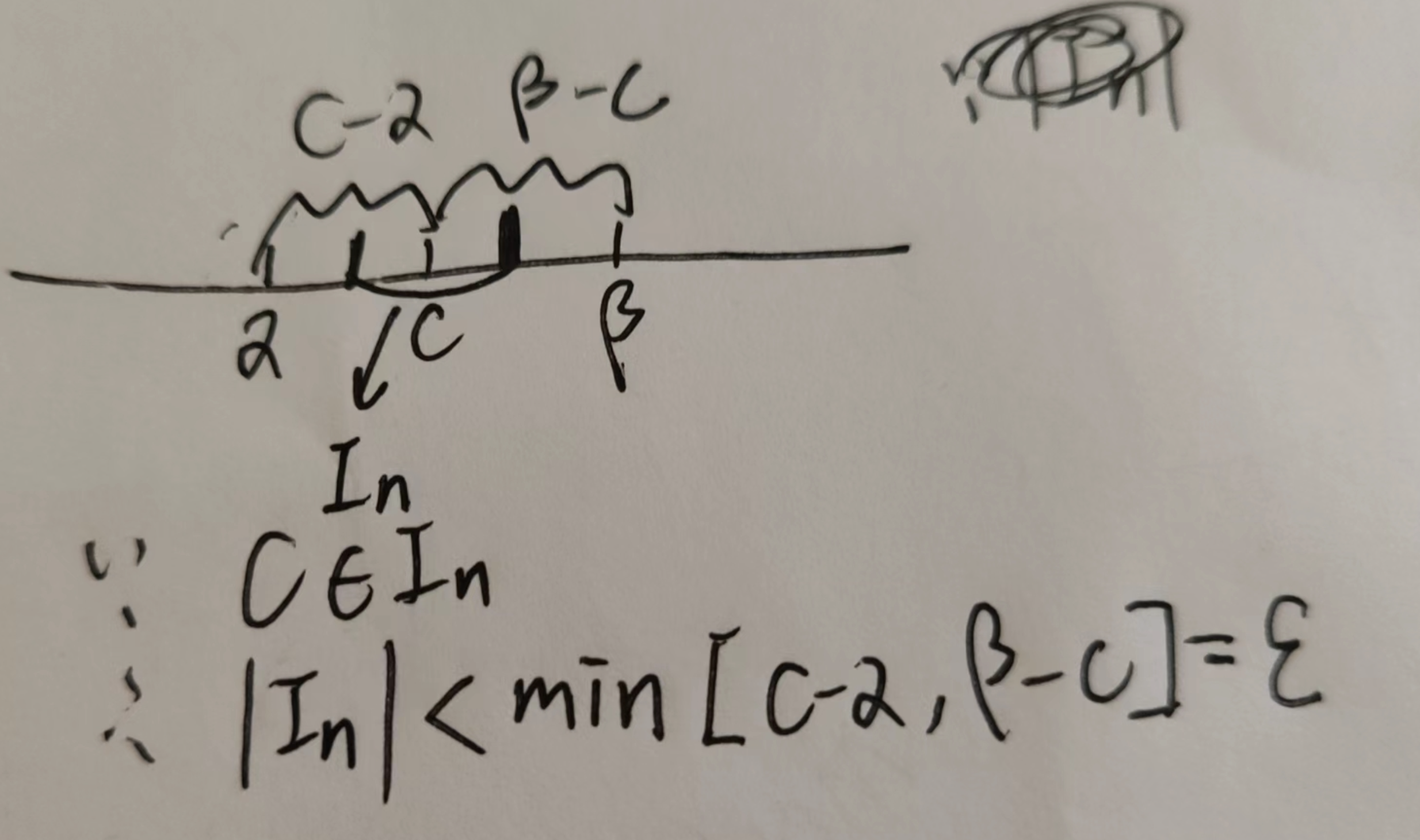
proof:
suppose \(I=[a, b]\) could not be coverd by finite number open intervals:
Then we use the method of bisection to separate I,s.t.
\[
\begin{aligned}
& I=I_1 \supset I_2 \supset I_3 \cdots I_n \supset \cdots \text { ( all In can not be covered } \\
& \left|I_n\right|=\frac{b-a}{2^n} \rightarrow 0 \\
& \text { Gover) } \\
& \Rightarrow \exists: C \in \bigcap_{i=1}^{\infty} I_i \text { (Cantor Nested Interral Property) } \\
& c_i\in[a_i,b_i]\\
& \Rightarrow C\in I\subset \bigcup U_i\text {(based on the given condition of the proof problem)}\\
& \Rightarrow \exists U=[\alpha,\beta],s.t.c\in U,let :\varepsilon =min[c-\alpha,\beta-c]\\
& \Rightarrow I_n\subset U
\end{aligned}
\]
which indicates that at least this \(I_n\) is covered by U, contradicting to the suppose.
so the finite covering lemma is true.
lecture notes
1
everything must be a reason during the process of proof. Patience is necessary!
limit
real number
history
Ancient Greece philosophy
Pythagoras, Archimede, Euclide,etc.
maths behave a discpline
study maths for its own sake! - number theory Q: rational number: a/b, a,b \(\in\) Z, b no 0
Greek believes: “Atoms”–Q are all numbers
geometry (length of sig \(\in Q\))
discovery: \(\sqrt 2\) in a square or … is not rational—kill
— no understanding of real number, irrational infinity… no corresponding of number and geometry
parallel—square using move
but it is not a possible thing to turn a circle into a square—\(\pi\) is not a rational number —–paradox: zhinuo and wugui—-convergence of a sum (they do not understand infinity and real number)
calculus
Newton Leibniz makes phy a idependent discipline
Newton’s Law–Kepler Law solve ODE:\(GMm/r^2=F=ma=mr^{..}\)
Philosophiae Naturalis Principil Mathematica. every theorem and lemma are detailed proved
–no understanding of real number but a little understanding of limit and infinity
analysis 19 century
Cauchy cantor weierstrass hilbert
understand real number infinity limit
the foundation of maths
Chaper 1: Logic(grammar) v.s. Maths(literature)
we should solve out logic first to logic important in–programming(some derivations of maths)
statement
p
—An assertion that is either true or false but not both
e.g.
Negation of a statement p is a statement which means the opposite of P
~p—-read “not p”
Quantifiers
all, every, each,no(none)—universal quantifiers
some,there exists, there is at least on, etc.—existential quantifiers
P: some a’s are b’s
~P: all a’s are not b’s/ no a’s are b’s
P: some a are not b
~p: all a are b
Truth table: give the truth values of related statements in all possible cases
(relevant to boolean in computer science)
# Example of boolean logic in a programis_raining =Truehas_umbrella =Falseif is_raining andnot has_umbrella: # which is the only situation that implication failsprint("You need an umbrella!")else:print("You're good to go!")
compound statement: combining several statements via logical operations
Conjunction: p^q. p and q
Disjunction: p v q–p or q
one of them is true, p v q is true, so we only need to decide if oe of them is true, if it is, the p v q is true
p V (~p) is always true
a statement that is always true is called a tautology
P10,1.4
Equivalence of statements: Two statements are logically equivalent, if they have the same truth values in all possible situations.
\(A\equiv B\)
‘abstract non-sense’
Them(De Morgan’s laws)
A,B
\(\sim (A \land B) \equiv (\sim A) \lor (\sim B)\)
\(\sim (A \lor B) \equiv (\sim A) \land (\sim B)\)
draw truth table to look at values
交的话(and),都T才T;并的话(or),1T则T
Conditional:
If p(hypothesis/assumption/condition), then q(conclusion/consequence/result).
read: p implies q/assume p, then q.
key point: the implication is False when the rule is broken
\[
\begin{array}{|c|c|c|}
\hline
A & B & A \rightarrow B \\
\hline
T & T & T \\
T & F & F \\
F & T & T \\
F & F & T \\
\hline
\end{array}
\]Def: p, q,p–>q
1)Converse: q—>p,i.e. if q, then p
2)Contrapositive: (q)–>(p), i.e. if not q, then not p
Prop: (p–>q)\(\equiv\) ((q)–>(p))(a statement and its contrapositive are logically equivalent) \[
\begin{array}{|c|c|c|c|c|c|c|}
\hline
p & q & \sim p & \sim q & p \rightarrow q & \sim q \rightarrow \sim p & (p \rightarrow q) \equiv (\sim q \rightarrow \sim p) \\
\hline
T & T & F & F & T & T & T \\
T & F & F & T & F & F & T \\
F & T & T & F & T & T & T \\
F & F & T & T & T & T & T \\
\hline
\end{array}
\]
(always remember: implication fails only when the rule brokens instead of……(others))
Proof by contradiction: we want to prove p—>q, we prove (q)—->(p) instead
proof: Assume ~q, if , then if , then … –> ~p, which is contradict to the original assumption p
Hence the assumption ~q is false, i.e. q is true.#
e.g.: n is a natural number. Prove that if n^2 is divisible by 2(p), then n is divisible by 2(q).
Proof: Assume that n is not divisible by 2(~q),—> n is odd(defination), i.e. n =2k+1,k\(\in Z\)
—> n^2 =(2k+1)^2(multiplicaiton)=2()+1, which is odd
—> n^2 is not divisible by 2(~p),
Thus the aassumption that n is not divisible by 2 is false so n is divisible by 2.#
biconditional: p,q,
(p–>q)\(\land\)(q—>p)—p <–> q—-reads‘p if and only if q’.
statement converse
\[
\begin{array}{|c|c|c|c|c|}
\hline
p & q & p \rightarrow q & q \rightarrow p & p \leftrightarrow q \\
\hline
T & T & T & T & T \\
T & F & F & T & F \\
F & T & T & F & F \\
F & F & T & T & T \\
\hline
\end{array}
\]
Them.: the only case p<–>q is true is then both p and q ture or false
Set Theory p13
proposition
$x,yQ $, x is less than y, \(\exists z\in Q\) s.t. x<z<y.
proof: \(x,y\in Q, x<y\),x=m/n,x=p/q,z=x+y/2\(\in\)(x+x/2,y+y/2),i.e.x<z<y,z=pn+mq/2qn\(\in \mathbb Q\) by defination.
Russel paradox
let R be the set of all sets that are not a member of themself. i.e.R={S|S\(\notin\)S}
so if \(R\in R\),R\(\notin\) R
if \(R\notin R\), R\(\in R\)
if \(x\in A\),then \(x\in B\) is the subset defination of A \(\subseteq\) B.
if \(A\subset B\), A is a proper subset of B. i.e. \(A\subset B\) if \(A\subseteq B\) and \(\exists x\in B\), s.t. \(x\notin\) A
\(N\subset Z \subset Q \subset R\)
Proposition
the empty set is a subset of any set
proof:
method1: (truth table)
method2:
Def
the complement of A is denoted by \(A^c\)
the intersection \(A \cap B\)
the union \(A \cup B\)
Countability and Bijections
Countable Set: A set is said to be countable if it is either finite or has the same size (cardinality) as the set of natural numbers \(\mathbb{N}\). A set is countably infinite if there exists a bijection (a one-to-one correspondence) between that set and \(\mathbb{N}\).
Uncountable Set: A set is uncountable if no such bijection exists, meaning its cardinality is strictly greater than that of \(\mathbb{N}\).
Bijection: A bijection between two sets \(A\) and \(B\) is a function \(f: A \to B\) that is both injective (one-to-one) and surjective (onto).
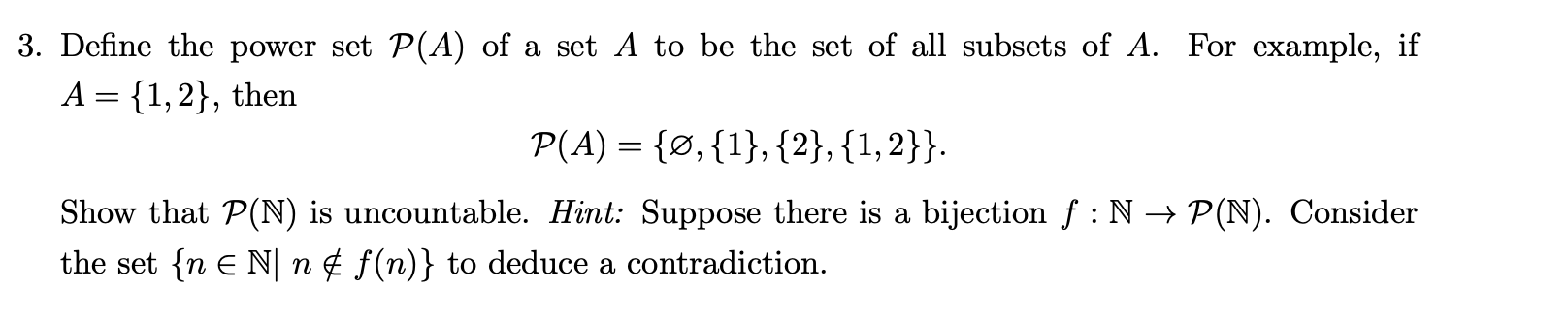
The Problem: Showing that \(\mathcal{P}(\mathbb{N})\) is Uncountable
method 1:
For each natural number n, if n is not in the subset f(n), we add n to the below A set; Otherwise, do not join. (just like the Cantor diagonal method (diagonal number is not in the range of the map so we add each of them into another set))
Consider the set \(A = \{ n \in \mathbb{N} \mid n \notin f(n) \}\), f : N → P(N).
we should prove it is not a bijection. so we could prove it is not surjective (P(N) is much bigger than N).
now we ask if f is surjective:
If yes, there exists \(n_0\in N\) s.t. f\((n_0)=\)A, A\(\subset\)N while A \(\in\) P(N)
now we ask: Does \(n_o\in f(n_0)\)
if yes, \(n_0\notin A=f(n_0)\)
if no, \(n_0\in A=f(n_0)\)
(or we discuss the set, we suppose x is in A and based on the condition of being in set A we get A is empty, which is contradicts to “x is in A”)
so f is not surjective, which means f could not be bijective. so p(N) is uncountable.
method2 (just back to method1’s way of construction): thinking but not complete and maybe not true——suppose the power set is countable:(analogy to Cantor’s diagnal method but we do not choose diagnal now)
for elements in the power set that has finitely many numbers, we repeat the last number to be infinity; for the infinity we just write down them directly—-all of them could correspond to a natural number unniquely by our assumption of countable property. (but this is meaningless for sovling this)
Then we could find a set that is not in the previous correspondence
eg of a bijection between 2 sets(namely 2 sets with the same size) see my Youtube vedio:
an eg question-Logical Puzzle on Truth of Statements relavent to truth table
Consider the following 99 statements:
\(S_1\): “Among these 99 statements, there is at most one true statement.”
\(S_2\): “Among these 99 statements, there are at most two true statements.”
…
\(S_{99}\): “Among these 99 statements, there are at most 99 true statements.”
The goal is to determine which statements among these 99 are true.
(hint:Consider the chain of implications from statement \(S_n\) to \(S_{n+1}\). Which statement implies which? )
sol: we fail the hypothesis of \(S_{n+1}\Rightarrow S_n\),but because
\[
\begin{array}{|c|c|c|}
\hline
S_n & S_{n+1} & S_n \Rightarrow S_{n+1} \\
\hline
T & T & T \\
T & F & F \\
F & T & T \\
F & F & T \\
\hline
\end{array}
\]
Thus, we conclude that the truth of \(S_n\) implies the truth of all subsequent statements \(S_{n+1}\).
)
\[
S_n \Rightarrow S_{n+1}
\] so there exists an \(S_n\), after which are true while before which are false.
so:There are \(100 - n\) true statements.
\[
100 - n \leq n \implies n \geq 50
\]
There are \(n - 1\) false statements.
\[
n - 1+1\leq 100 - n \implies n \leq 50
\] so The 50th statement \(S_{50}\) is true. Statements \(S_1\) to \(S_{49}\) are false, and statements \(S_{50}\) to \(S_{99}\) are true.
Cardinality
numebr of elements in a finite set: Def: let A be a set, if A contains finitely many elements, then the number of elements of A is called the cardinality of A, denoted by |A|(|A|\(\in Z_{\geq0}\)
A, B have infinitely many elements. If \(\exists f:A->B\) is a bijective map, then we regard the A, B have the same “cardinality”, i.e.|A|=|B|
A x B–Cartesian product
eg
|A|=3, |B|=2, |A x B|=6
map
Question from the Cardinality:
What happens if A has infinitely many elements?
Def: LEt A and B be 2 sets, A map(function)f: A–>B assigns each element in A
there has 3 kinds of maps(see 107)
eg
the graph of f(x) in A x B is f: A–> B(x \(\in A\),y\(\in B\))
inverse defination
if f is a bijective map, so as \(f^{-1}\).
countable
A set A is called countable if A iseither a finite set of there exists a bijective map f: A to N.(Otherwise is uncountable)
eg
\(B=[x|x=2n,n\in N\) is countable
proof: for x|–>x/2 of B–>N i) injective , $x_1 $ not = \(x_2\), f(x_1)=x/2, = f(x_2)
   ii) surjective, $\forall y\in N $, $\exists x\in B$ s.t. ,f(2y)=x, $2y\in B$

   so bijective
Z is countable (负无穷到正无穷范围内的整数)
f:N–>Z(n|–>n/2 if even, 1-n/2 if odd)
n|–>n/2 if even makes the positive integer possible
So Take \(M=m \cdot a x\left\{10, \frac{22}{M_1 a}, \sqrt{\frac{18}{m_1 \varepsilon}}\right\}\), we hame \(\forall \varepsilon>0, \forall|x|>m\), such that…<\(\epsilon\)
In the same manner as above, the conditions on \(\delta\) give us that: \[
\begin{array}{ll}
& c-\delta<x<c \\
\wedge \quad & c<x<c+\delta \\
& 0<|x-c|<\delta
\end{array}
\]
So: \[
\forall \epsilon>0: \exists \delta>0: 0<|x-c|<\delta \Longrightarrow|f(x)-l|<\epsilon
\]
Prove f is continuous at x when x \(\in[0,1]\) and x is not in A
notice!!! Do not choose sequence convergent to a point that we want blindly, since there may exists no such sequence like that! For example, here, by the density of rational/irrational number, there exists no sequence composed by elements in A convergent to a point at [0,1]so we should think of another way to prove this—If b\(\in [0,1]\A\), then there is an n_0 such that$ 1/2(n_0+1)<b<1/2n_0,$ i.e. b\(\in (1/2(n_0+1),1/2n_0).\) For any sequence $a_n [0,1] $with $ lim_n a_n=b,$ there is an N>0 such that \(a_n\in (1/2(n_0+1),1/2n_0).\) ( It works as the following: We take an \(\epsilon=1/2 min{|1/2(n_0+1)-b|, |1/2n_0-b|}, then there exists an N.0 such that |a_n-b|<\epsilon.\) ===> when n>N, a_n\(\in(b- \epsilon, b+ \epsilon)\subset (1/2(n_0+1),1/2n_0) )\) Notice that (1/2(n_0+1),1/2n_0) does not intersect with A. Therefore f(a_n)=0. lim_nf(a_n)=0=f(b). Hence f is continuous at b.
method 1 sequential
method 2
Prove f is not continuous at each point on A
method 1 limit or \(\epsilon-\delta\)
method 2 sequential creterion
Though below are equivalent:
\(\alpha\) is an upper bound of f and \(\alpha\) is a a functional limit of one or some sequences in the domain of f —-\(\alpha\) is the supremum of f.
Sup is different from limit – an experience from final exam
The n in them are different—
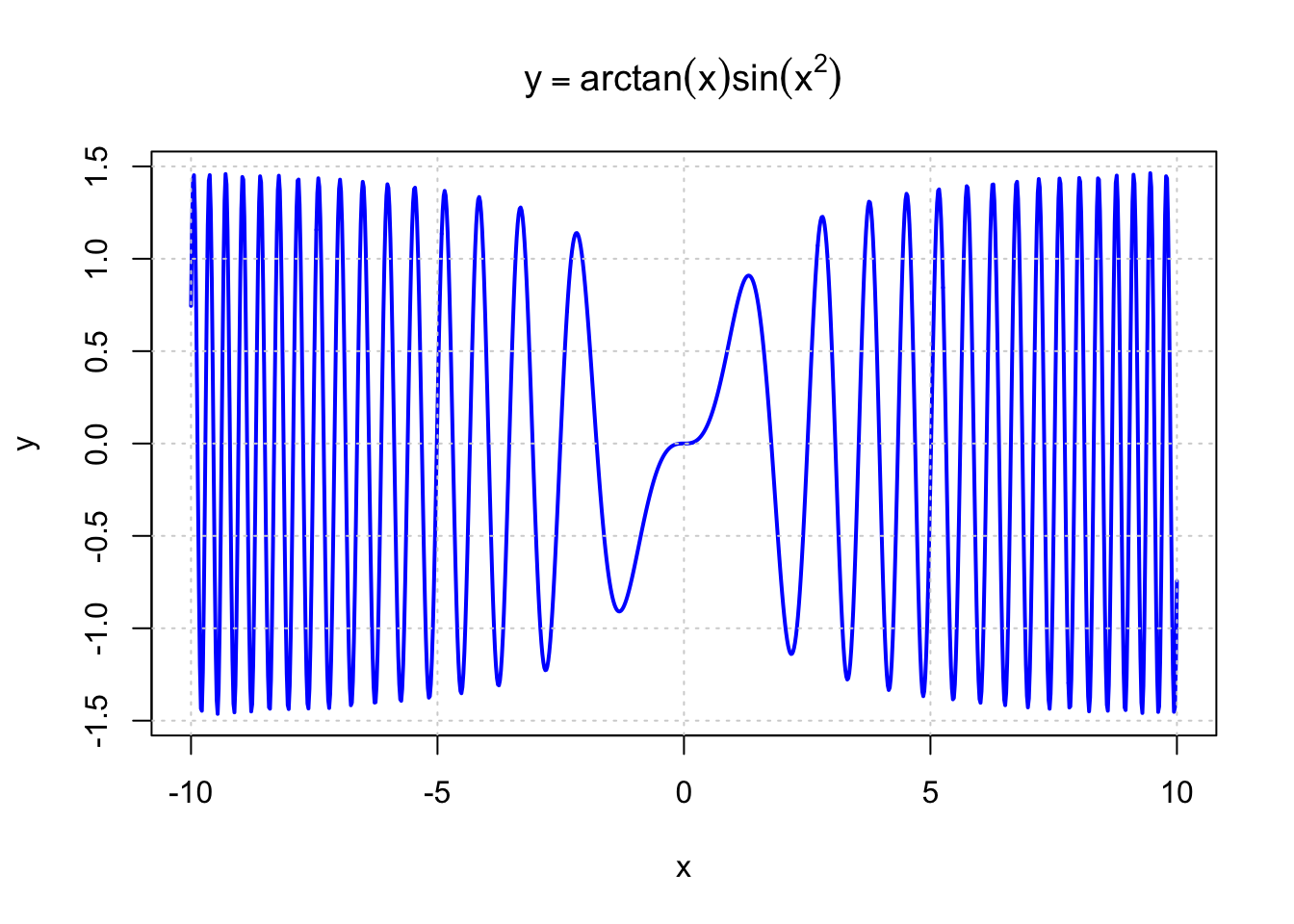
\(\tan^{-1}x \sin x^2\)
# Define the functionf <-function(x) {atan(x) *sin(x^2)}# Generate a sequence of x valuesx <-seq(-10, 10, length.out =1000)# Compute the corresponding y valuesy <-f(x)# Plot the functionplot(x, y, type ="l", col ="blue", lwd =2,main =expression(y ==arctan(x) *sin(x^2)),xlab ="x", ylab ="y")grid()
its supremum exists, which is \(\pi /2\), however, its limit does not exist.
Reason: for sup we only need one “existence of \(x_0\)” since it says \(\forall n \in N\)\(\exists x_0 \in R\) s.t. \(M < f(x_0) <M+ \epsilon\)
but for the limit we need all x greater than a number that \(|f(x) - M| < \epsilon\)
For this specific example, we know that each top of \(\sin x^2\) we have satisfied \(|f(x) - M| < \epsilon\) but NOT ALL!
eg question from Dr. Chi-Kwong Fok about Weirestrass-Extream Value THM (continuous function in a compact set attains its max and min)
If f is a continuous and non-surjective function and the supremum of it in [0,\(+\infty\)] is not in its range. show that $ >0, x > 0, z R z > x, $
Firstly, negate it: \(\exists \epsilon_0 >0,\) s.t. \(\exists x_0 >0, \forall z \in R\) with z>\(x_0\), f(z) $ M-_0, $ where M is sup R(f) —(1)
Secondly, write down the def of M is sup:
\(\forall \epsilon >0, \exists x\in [0,+ \infty],\) s.t. f(x)>\(M-\epsilon\). Now take the global $$ to be \(\epsilon_0\) —(2)
By (1) and (2) we know that \(\forall \epsilon >0, \exists x\in [0,x_0],\) s.t. f(x)>\(M-\epsilon\) Now take the global $$ to be \(\epsilon_0\)
By Weirestrass-Extream Value THM (continuous function in a compact set attains its max and min) we know it attains its maximum in [0,x_0]. Suppose this maximum is not the sup, then M=supR(f) < its maximum, then by the IVP it must attain sup R(f) contradiction. =–also. —contradiction
a problem about divisible using greatest common factor to solve(even Bezou’s theorem)
Q:“Proof that if a positive integer \(p\) is not a perfect square, then \(\sqrt{p}\) is irrational.”
Sol: Proof by Contradiction:
Assume \(\sqrt{p}\) is rational.
Since \(p\) is not a perfect square, there exist two coprime positive integers \(m\) and \(n\) with \(n > 1\) such that \[
\sqrt{p} = \frac{m}{n}
\]
Then \[
p = \frac{m^2}{n^2}
\]
which implies \[
m^2 = n^2 p
\] i.e. \(n^2 \mid m^2\). Then We want to show that \(n \mid m\):
Suppose \(m^2 = k n^2\), where \(k \in \mathbb{Z}\).
Since \(m\) and \(n\) are both integers, based on prime factorization, we have:
\[
m = p_1^{a_1} p_2^{a_2} \cdots p_k^{a_k}
\]
\[
n = p_1^{b_1} p_2^{b_2} \cdots p_k^{b_k}
\]
where \(p_i\) are prime numbers, and \(a_i, b_i\) are non-negative integers.
Thus, \(m\) is divisible by \(n\). Therefore, \(n \mid m\), which is opposite to m and n are coprime. So, \(\sqrt{p}\) is irrational.
method 2: Proof by Contradiction:
Assume \(\sqrt{p}\) is rational.
Since \(p\) is not a perfect square, there exist two coprime positive integers \(m\) and \(n\) with \(n > 1\) such that \[
\sqrt{p} = \frac{m}{n}
\]
Then \[
p = \frac{m^2}{n^2}
\]
which implies \[
m^2 = n^2 p
\] i.e. \(n^2 \mid m^2\). So \(n \mid m^2\)
Since \(n > 1\), it follows that there exists a prime number \(r\) such that \(r \mid n\). (proof using Fundamental Theorem of Arithmetic:
Every integer greater than 1 is either a prime or can be uniquely factored into prime numbers.
If \(n\) is a prime number, then \(r = n\) and clearly \(r \mid n\);
If \(n\) is not a prime number, it must be decomposable into a product of prime factors. Therefore, we can write: \[
n = p_1^{e_1} p_2^{e_2} \cdots p_k^{e_k}
\]
where \(p_i\) are prime numbers and \(e_i\) are positive integers.
Since \(n\) is a product of prime factors, at least one of these prime factors \(p_i\) must divide \(n\).
Let \(r = p_i\), which is one of the prime factors. Then \(r \mid n\).
Thus, in both cases, whether \(n\) is a prime or not, there exists at least one prime number \(r\) such that \(r \mid n\).)
Thus \[
r \mid m^2 \quad \text{and} \quad r \mid m
\] (proof of \[
r \mid m^2 \quad \text{and} \quad r \mid m
\]: proof1 using prime factorization as method 1’s:
\(r \mid m^2\) and r is a prime so \(r=p_i\) corresponding to the exponential of \(2a_i\)
since \(a_i \geq 0\), so \(a_i\) is at least 1 . proof2 using if r is a prime and r|ab, then r|a or r|b:
Suppose \(r \nmid a\) and \(r \nmid b\) (contradiction assumption).
Let \(\gcd(a \cdot b, r) = d\) (where \(d\) is the greatest common divisor of \(a \cdot b\) and \(r\)).
Since \(d \mid r\), \(d\) is a divisor of \(r\) (since \(r\) is a prime number).
Therefore, \(d\) is either \(r\) or \(1\) (since \(r\) is prime).
if \(d = r\), we have \(\gcd(a \cdot b, r) = r\). This implies \(r \mid a \cdot b\).
Since we assumed \(r \nmid a\) and \(r \nmid b\), it contradicts our initial statement based on Properties of greatest common divisor with its proof using Bezou’s theorem;
If \(d = 1\), we have \(\gcd(a \cdot b, r) = 1\). This implies \(r \nmid a \cdot b\), which contradicts our assumption that \(r \mid a \cdot b\).
Thus, the contradiction shows that our assumption \(r \nmid a\) and \(r \nmid b\) must be false. Therefore, \(r\) must divide at least one of \(a\) or \(b\).
)
Since \(m\) and \(n\) are coprime, this leads to a contradiction.
Therefore, \(\sqrt{p}\) must be an irrational number.
everything goes smoothly in exams but not during the learning process
compact -“closed and bounded” is just appropriate for the real number set, but for the general metric space is not true—the real meaning is “every open cover has a finite subcover”
Gauss is a fox, and the fox’s tail sweeps away the places he has passed through. —Abel
Gauss had the habit of not writing down his proofs, which made it difficult for others to understand his work. He had good habits of writing his daily work in his diary, which was a good way to keep track of his progress.
Read Euler, read Euler, he is the master of us all. —Laplace
Euler telled us both the true things and the false things in mathematics. He demonstrated the whole thinking process of mathematics.
Not only did Euler did good mathematics research but also he was a good teacher. He had cultivated lots of students. He wrote a lot of books and papers, which were very helpful for the development of mathematics.


 (notice! The rational number set does not satisfy completeness since if we choose a subset of Q, which is all rational numbers less than